

Before we begin: This week’s episode of Like Me features the OG Extremely Online Woman (and my former manager), Olivia Howell. Despite having considered her one of my best friends for close to 15 years, we have never met in real life. Let’s just say we had a lot to get into.
Check out Fresh Starts Registry
Follow @likemepod & @oliviahowell on IG
And now, on to the Topic of the Day: Loneliness.
Witness
On the most recent episode of House on Fire, the podcast I co-host with Behavioral Psych Studio, Dr. Stefanie Sugar and I decided to talk about loneliness. Because who among us…isn’t? It’s not just technical alone-time I’m talking about…it’s the loneliness that seems to come hand-in-hand with aging. The kids get older. Relationships fade. You stop prioritizing IRL connection over a nice, long nap.
Anyway, this conversation got me thinking about a weekend I spent in a tiny town in Northern California a few years ago, shortly after completing a week-long off-grid retreat at The Hoffman Institute (which I definitely need to get into in greater depth at some point; that was quite the experience).
When I left the retreat – after seven days with no access to phones or computers, no music, no books, nothing to do but look myself straight in the eye and see what, if anything, I might find – I didn’t go home; not right away. Part of the commitment I made when I signed up for the retreat was to spend the two days following my departure somewhere quiet, all by myself. The hope was that I’d be able to use the time to figure out how to take what I’d learned into my *real* life: the earsplittingly loud, endlessly busy one filled with responsibilities and distractions and triggers and proposals that need to be written and homework that needs to be finished and meals that need to be cooked.
So I booked two nights in an Airbnb in a town called Occidental. I found it because I did a quick search for inexpensive places to stay in Napa, and picked a home that sat next to a little pond, and had a hammock strung up between two apple trees.
I expected to feel frantic during those first couple of days on the “outside,” as it were – panicked by the number of emails I’d missed; desperate to find out what had happened to everything from my kids to the news cycle while I’d been gone. But on the morning of my last day at the retreat I was handed back my phone…and I didn’t want it, to the point where I felt full-on physical revulsion.
I turned the phone on anyway, and the notifications poured in. Messages that had to be returned; book edits that had to be approved; appointments that had to be confirmed. And then I heard a voice in my mind so clearly that I wondered whether I’d said the words out loud.
It can wait.
All of it can wait.
On the first evening of my stay in Occidental, I drove into town with no plans in particular. There was a tiny street fair set up along the main road, and I stopped at a jewelry stand run by a man who made one-of-a-kind silver rings for a price that couldn’t have been much more than what they cost to create. I decided that one of those rings would be the thing that I’d buy and take home with me to help me remember what I’d so recently found.
I waffled back and forth between a ring with an opal and one with hematite. I felt like it was important, somehow, that I get it right, this first decision I’d be making “after,” even though it was a such a silly, small decision to make. I loved the opal, but I ended up choosing the other ring for its meaning. Hematite, Google told me, is a stone even stronger than iron.
I wandered off, out of the street fair, and into a store that was all hanging dreamcatchers, leather-bound journals, and crystal jewelry. The moment I stepped through the door, the woman behind the counter stopped me. There’s a hunter’s moon tonight, she said. I don’t know why I’m telling you this, but I feel like I need to.
I know it sounds odd, but at the time it seemed like the most natural thing in the world. We ended up chatting for awhile, and she read me the meaning of that night’s moon: It signified an acknowledgment of the hard, unseen work. A promise from the universe that the places where you choose to invest your energy will not go unnoticed.
When I left the shop it was getting dark, and the street fair was starting to shutter. But first, I did a strange thing: I walked back to the jewelry stand and asked the proprietor whether it’d be okay if I changed my mind. I’d decided I wanted the opal instead. I didn’t look up the meaning of an opal; it didn’t matter. I thought it was beautiful, and it mattered to me.
The man told me he’d thought of me after I’d left and wondered whether I’d chosen the ring I really wanted. He was happy, he said, that I’d come back.
Late that night, I saw a shooting star. I’d never seen one before, not ever.
In the morning, I woke up to what I’d thought was the sun flooding in through my window, but what turned out to be the moon, still hanging – bright orange and huge – in the sky. I walked by the pond, and watched frogs leaping out of my path into the water. I slept under the apple trees.
One night I went into town for dinner and realized upon arriving that I’d forgotten my wallet, but when I turned to leave the owner of the restaurant insisted I sit. She sent me bruschetta, a pizza pie, and a glass of local wine. She waved off the bill, and told me to send her a check when I got home. We hugged good-bye.
After considerable introspection, I now know that one of the biggest reasons why I thought that getting married wasn’t just “an option” but actually essential to my identity and sense of self was this: Lifelong partnership provides you with the chance to be seen. That’s not a flattering realization; I wish it wasn’t so. But experiences have always seemed more visceral, more there, when I have someone next to me, experiencing them, too. My partner’s brain contains a recording of the very same events as my own. And in their memory, when they think back on that moment, or that event…I am there, too.
I am, therefore, real.
I think I chose to do what I do – write about my life for a living – out of a similar desire: I want to feel like the things that happen to me actually happened.
A few weeks after I got back home, I lost my opal ring at the beach. I was digging in the sand with my kids, and at one point I looked down and realized that it was gone. We hunted around for awhile, but we’d been running all over the beach, jumping in the water, building sandcastles and digging tunnels. I found myself getting upset – the ring had felt like a symbol, something to hang on to when I forgot which direction I was going in – but then it occurred to me: I lost that ring while playing at the beach with my children.
I liked the ring a lot.
It was just a ring.
Even so, I thought I’d try to find the jewelry maker online and see if I could order another – I did really like it – but I didn’t know the name of the company, or anything about them. So I reached out to the woman who’d told me about the harvest moon; I sent her a DM on Instagram through the shop’s handle. She reached out to friends who’d been at the market that night; she reached back out to me. And so it happened that I found the man who made my ring – not a company, just a person – and he said of course he’d make me another.
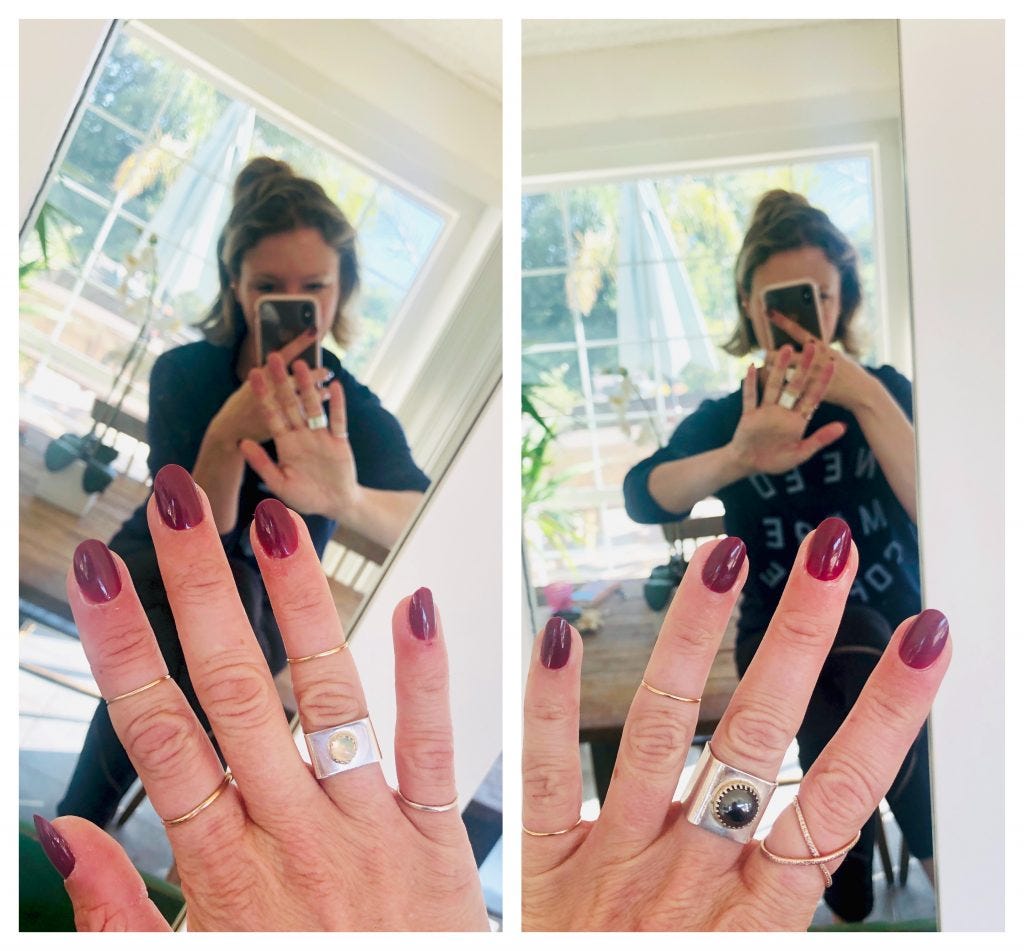
The package arrived a few nights later. In it was a new opal ring – a perfect replica of the one I’d lost in the sand. And there, swaddled in the cotton next to the opal: a gift. It was the ring I’d owned for just a few minutes, while walking alone through a town where I knew not a soul. The ring with the stone that’s stronger than iron.
Did you know that there’s no word in our language for “the opposite of loneliness”? It’s true; there’s no direct antonym. Because loneliness doesn’t just suggest physical solitude – there’s a melancholy to it that’s hard to put into words. And so it’s harder, still, to speak to its absence.
In searching for the best way to describe how I felt during that weekend in Occidental – and how I still feel, so often that I surprise myself – I find myself looking for that word: The one that means the opposite of loneliness. The word that doesn’t exist.
So I am forced to find my own word – and I think, maybe, this is what it comes down to: There, in that sweet little town, just me and some strangers and a pair of apple trees that held me while I slept, I did not feel lonely.
I felt alone.
Simply, quietly alone.
It was just what I’d been looking for.